Nowadays, under the advocacy of the concept of green lighting, various lighting technologies are constantly emerging. Fiber optic lighting and LED lights, as emerging lighting technologies, have always been at the forefront of the green lighting field.
I. Fiber Optic Lighting
Fiber optic lighting is a new lighting method that has emerged in recent years. Due to some unique physical properties of optical fibers themselves, fiber optic lighting is applied in interior decorative lighting, local effect lighting, billboard lighting, guiding lighting in outdoor public areas of buildings, indoor and outdoor underwater lighting, as well as building contour and facade lighting, and has achieved good lighting effects. A fiber optic lighting system consists of a light source, a reflector, a color filter, and optical fibers. When the light source passes through the reflector, it forms a beam of approximately parallel light. Due to the effect of the color filter, this beam is transformed into colored light. When the beam enters the optical fiber, the colored light is transmitted along the path of the fiber to the predetermined location. Due to light loss along the way, the light source is generally very strong. Common light sources range from about 30-100W. Moreover, to obtain an approximately parallel beam, the light-emitting point should be small as possible, close to a point light source. The reflector is a key factor in obtaining an approximately parallel beam. Therefore, aspherical reflectors are generally used. The color filter is a component that changes the color of the beam. needed, by replacing different color filters, corresponding colored light sources are obtained. Optical fibers are the main component of the fiber optic lighting system, and their function is to transmit or emit light to a predetermined location. Optical fibers are divided into two types: end-emitting and side-emitting. The former transmits the beam to the endpoint, where it illuminates through a tail light, while the latter itself is a light emitter, forming a flexible light column. As for the material of optical fibers, it must have minimal light energy loss within the visible light range to ensure lighting quality. However, in practice, some loss is inevitable, so the optimal transmission distance for optical fibers is about 30m.
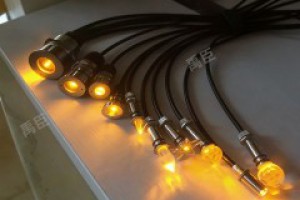
Characteristics of Fiber Optic Lighting:
A single light source can have multiple light-emitting points with identical luminous properties.
The light source is easy to replace and maintain.
The light emitter can be placed in locations inaccessible to non-professionals, thus offering anti-vandalism properties.
No ultraviolet or infrared light, reducing damage to certain items such as cultural relics and textiles.
Light-emitting points are miniaturized, lightweight, easy to replace and install, and can be made very small to be placed inside glassware or other small objects to create special decorative lighting effects.
No electromagnetic interference, allowing use in special places with electromagnetic shielding requirements, such as MRI rooms and radar control rooms.
No sparks or risk of electric shock, enabling use in special places with fire or explosion hazards or damp, water-rich environments, such as chemical, oil and natural gas platforms, fountain pools, and swimming pools.
Automatic color change capability.
Reusable, saving investment costs.
Flexible, easy to bend, not easily broken, and easy to process into various patterns. System heat generation is lower than that of general lighting systems, reducing the electrical energy consumption of air conditioning systems.
II. LED Lighting
LED (Light Emitting Diode) is a semiconductor that converts electrical energy into visible light. It changes the principle of incandescent lamp filament emission and energy-saving lamp tri-phosphor emission by using electric field luminescence. It has the following characteristics:
Voltage: LEDs use low-voltage power supplies, with supply voltages ranging from 6-24V, depending on the product, making them safer than high-voltage power supplies.
Efficiency: Energy consumption is reduced by 80% compared to incandescent lamps with the same luminous efficacy.
Applicability: Each LED unit chip is a 3-5mm square, allowing it to be made into devices of various shapes and suitable for easily changing environments.
Stability: 100,000 hours, with light decay to 50% of the initial value.
Response time: The response time of incandescent lamps is in milliseconds, while that of LED lamps is in nanoseconds.
Environmental pollution: No harmful metal mercury.
Color: Changing the current can alter the color. LEDs can easily achieve multi-color emission in red, yellow, green, blue, and orange through chemical modification methods to adjust the material's energy band structure and bandgap.
Price: LEDs are relatively expensive; the price of a few LEDs can be equivalent to that of an incandescent lamp, and each set of signal lights typically requires 300-500 diodes.
III. Application Areas of Fiber Optic Lighting
Desktop lighting for video conferences
Effect lighting in places with high ceilings, difficult to maintain, or unable to bear weight
Guiding lighting in public areas of buildings
Underwater lighting for outdoor fountains
. Building contour lighting and facade lighting
Localized lighting for buildings and cultural relics
Light box and billboard lighting
Side-emitting optical fibers are flexible, easy to bend, not easily broken, easy to process into different patterns, pose no risk of electric shock, require no high-voltage transformers can automatically change light colors, are convenient for construction and installation, and can be reused. Therefore, they are often used for billboard lighting on buildings. Compared to traditional neon lights, fiber optic lighting has clear performance advantages.
IV. Application Fields of LED
Signal indication applications.
Display applications: Signboards, billboards, large-screen displays, etc.
Lighting applications:
a. Portable lighting: Flashlights, headlamps, miner's lamps, diving lamps, etc.
b. Automotive lighting: High-mounted brake lights, brake lights, turn signals, reverse lights, etc. High-power LEDs have been widely used in automotive lighting.
c. Special lighting: Solar garden lights, solar street lights, underwater lights, etc. Due to the small size of LEDs, facilitating dynamic brightness and color control, they are suitable for architectural decorative lighting.
d. Backlighting: Backlights for functional displays in common electronic devices, laptop computer backlights, backlights for large and ultra-large LCD displays, etc. LEDs as backlights for mobile phone displays are the most widespread application of LEDs.
e. Projection light sources: RGB light sources for projectors.
f. General lighting: Various general-purpose lighting fixtures, lighting sources, etc.
Since fiber optic lighting and LED lighting have fundamental differences and each has its own unique performance effects, their sales markets also focus on different areas. Although fiber optic lighting currently holds a relatively small market share in the lighting industry, it is growing at a proportional and accelerating rate. Based on the characteristics of fiber optic lighting, its sales market mainly targets decorative lighting, entertainment lighting, artistic lighting, and special lighting.
As a new type of light source, under the current development trend and the concept of green lighting, the variety of LED lighting products developed in recent years has increased, and the market share is also growing. However, due to the immaturity of high-power LED technology and the inability to effectively reduce the cost of white LEDs, LED lighting fixtures cannot expand effectively in the lighting field.
 WhatsApp
 Follow WeChat