Must solar cells be flat? Researchers at the Georgia Institute of Technology have recently developed a new technology that can transform optical fibers into slender solar cells. By combining dye-sensitized solar cells with the outer shell of fiber optic cables, the Georgia Tech researchers have demonstrated a thin, flexible solar cell, which is said to be six times more efficient than flat solar cells made from the same materials. "We point the end of the fiber directly at the sun," said Zhong Lin Wang, a professor at Georgia Tech. "By placing an electrode connected to an external load next to the fiber, we can collect the generated charge." Wang conducted this research alongside fellow researchers Benjamin Weintraub and Yaguang Wei from the institute.
Professor Zhong Lin Wang of Georgia Tech showcases a solar cell made from fiber optic cable materials. Dye-sensitized solar cells, invented in the 1990s, are a thin-film solar power solution. Unlike silicon solar cells, which use expensive semiconductor materials to generate electricity, dye-sensitized solar cells employ inexpensive dye molecule films on zinc oxide nanowires, surrounded by an electrolyte with a metal film. When sunlight strikes the dye molecules, they emit electrons into the metal film, which are then transmitted to an external electrode.
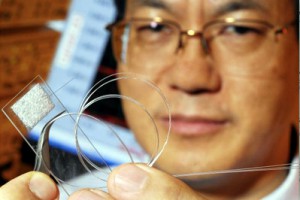
One issue with traditional solar panels is that incident photons have little opportunity to excite electrons within the thin panel before they degrade into heat. In contrast, optical fibers allow photons more opportunities to interact with the active layer. Wang’s prototype uses a 20-centimeter-long fiber to ensure maximum photon absorption along its length. This technology currently collects sunlight only from the tip of the fiber, with the light traveling down the fiber. Future versions may incorporate an external transparent metal sheath to allow light to enter from both inside and outside. The researchers also plan to create bundled subsystems consisting of hundreds of parallel fiber optic cables.
The research team aims to increase the energy conversion efficiency of this new solar cell from the current 3.3% to 8% to make it commercially viable. Wang stated that he intends to experiment with lower-cost, inexpensive fiber materials and replace zinc oxide with titanium oxide to further improve efficiency. In practical applications, this solar cell could enable product designers to develop commercial products with new shapes. In military applications, fiber-like solar cells could be embedded in equipment to provide power.
 WhatsApp
 Follow WeChat