Although fiber optic lighting and LEDs each have their own characteristics and overlapping application areas, their effects still possess distinct features. Excellent fiber optic lighting is highly personalized, capable of meeting people's diverse needs for light environments. Its decorative effects are breathtakingly beautiful—constellations and starry skies evoke the tranquility and romance of the night; flowing fiber optic waterfalls bring to mind the classic scene of "a waterfall cascading down three thousand feet, as if the Milky Way were falling from the heavens"; the randomness of fiber optic three-dimensional mirrors, with their mottled patterns like osmanthus rain descending to the mortal world, constantly stirs curiosity; fiber optic curtains sway gracefully, fresh and elegant, as if transporting one back to the poetic imagery of "the west wind rolling up the curtain." Gazing at the starry sky outside the window, the shimmering points of light seem within reach, bringing joy to the heart; reaching out to pluck a star, only to find it is a fiber optic mesh screen. Fiber optic lighting can coexist with people and their surroundings, even achieving a state of harmony between light and people, and between scene and atmosphere.
With the development and maturation of various colored LEDs, the technology for creating color-changing effects using single-color LEDs for entertainment purposes has also become increasingly advanced. To alter colors, systems typically use red, green, and blue LEDs (RGB) as monochromatic light sources, employing a technique known as "color addition" to produce the desired final hues.
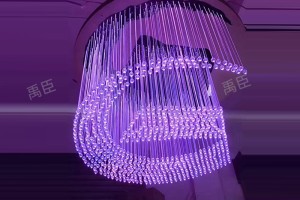
However, in terms of the expression of light, no other lighting method can compare to fiber optic lighting. Therefore, in terms of development trends, fiber optic lighting still holds a dominant position.
Due to the fundamental differences between fiber optic lighting and LED lighting, as well as their distinct expressive effects, their sales markets also have their respective emphases.
Although fiber optic lighting currently does not occupy a large share of the lighting industry market, its growth is accelerating proportionally. It continues to attract attention at the annual American Lighting Products Exhibition, particularly in places where conventional lighting is inconvenient. For locations that are difficult to access or require separation of light and electricity, fiber optic lighting systems are most advantageous. Based on the characteristics of fiber optic lighting, its sales market primarily targets decorative lighting, entertainment lighting, artistic lighting, and special lighting.
As a new type of light source, under the current development trends and the concept of green lighting, the variety of LED lighting products has been increasing in recent years, and their market share is also growing. However, due to the immaturity of high-power LED technology and the inability to effectively reduce the cost of white LEDs, LED lighting has not been able to expand effectively in the field of illumination.
 WhatsApp
 Follow WeChat